

Piano Lessons vs. Apps Like Simply Piano - Which Is Actually Better?
Honestly, I love that people are asking it - because it tells me that more people than ever are thinking about learning the piano. And that, for me, is always a good thing.
A Different World
When I was growing up in the 90s, apps weren't even a thing. The idea of learning piano from your phone would have seemed like science fiction. There were DVDs, the occasional home learning course, and that was about it - and even those didn't have the best reputation. The general feeling was: if you want to learn properly, you get a teacher. Full stop.
Fast forward to 2026, and the landscape has completely changed. There are apps, YouTube channels, online courses, tutorials, TikTok videos - more ways to engage with the piano than ever before. And I think that's genuinely brilliant.
The Apps That Are Out There
Let's talk about the main ones, because they're worth knowing about. Here are the three most popular piano learning apps right now, along with their current UK pricing:
Simply Piano - One of the most well-known piano apps in the world. Structured around courses split into Soloist and Chords pathways, with a library of over 5,000 songs. It listens via your device's microphone and gives real-time feedback. Great for absolute beginners and children.
Monthly: approx. £13-£18/month
Yearly: approx. £90-£120/year
14-day free trial available
Flowkey - Endorsed by Yamaha and used by over 10 million pianists worldwide. Offers step-by-step courses, a huge song library, and works with both acoustic and digital pianos. Widely considered the most comprehensive of the three.
Monthly: £13.99-£19.99/month
Yearly: £79.99-£119.99/year
Free version available with limited songs
Yousician - The most game-like of the three, with a competitive, points-based format. Works across piano, guitar, ukulele and more. Good for beginners who are motivated by challenges and leaderboards, and a great way to build early practice habits from home.
Monthly: from £4.99/month (single instrument)
Yearly: from £59.99/year
Free version available (limited to 15 minutes per day)
(Prices correct at time of writing and may vary by platform and region.)
My Honest Opinion on the Apps
Here's the thing - and this might surprise you coming from a piano teacher - I genuinely welcome these apps. All of them.
Because here's what they do brilliantly: they get people started. They make the piano feel accessible. They remove the anxiety of walking into a lesson with a stranger and not knowing anything. They let someone sit at home, on their own terms, and just begin. And for a lot of beginners, that first step is the hardest one.
If someone is happy on an app forever and they're having fun - that is the point. That is genuinely enough. Music is for everyone, and if an app is the way someone connects with the piano, then that app has done its job beautifully.
Where the Apps Start to Fall Short
But here's where it gets interesting. Because there does come a point - and most app users will recognise it - where you feel like you're doing so much, and yet something is missing.
The apps can't see your hands. They can't correct your posture. They can't tell you that the tension in your wrist is going to cause you problems in six months. They can't hear the musicality - or lack of it - in your playing. They can't adapt to you as a person, understand how you learn, or know that you've had a hard week and need a different kind of lesson today.
That's where a piano teacher comes in. And that's where one-to-one piano lessons will always win.
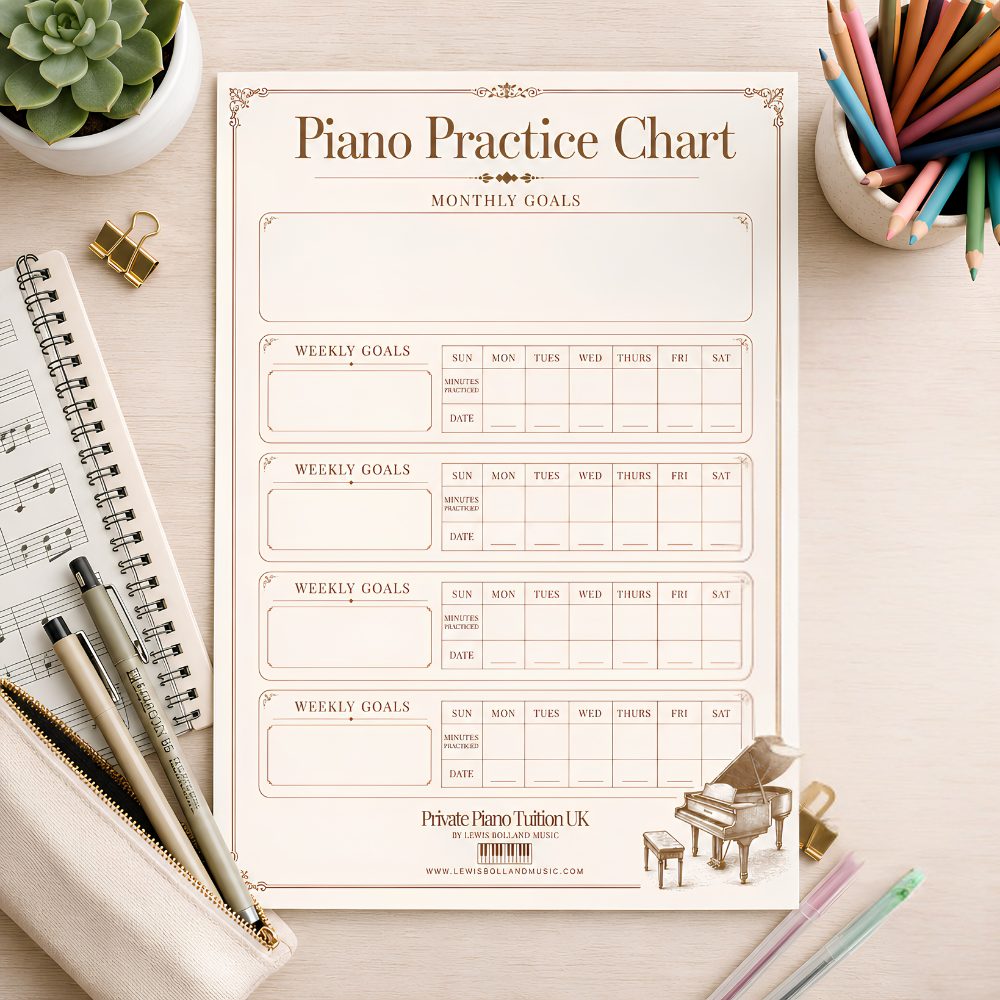
Piano Practice Chart — A Printable Monthly & Weekly Goals Tracker is a clear, elegant practice sheet designed to help students build consistency without pressure.
This chart gives students (and parents) a simple structure to plan goals, track minutes practised, and create a steady rhythm of progress—week by week.
It includes:
A large Monthly Goals section
Four Weekly Goals sections
A weekly grid (Sun–Sat) to record minutes practised and the date
A clean, uncluttered layout that’s easy to use and satisfying to fill in
Whether you’re supporting a child’s practice routine or returning to piano as an adult, this chart is designed to make practice feel calmer, clearer, and more achievable.
Ideal for:
beginner piano students
parents supporting practice at home
teachers and studios
practice rooms and home learning
adult learners building routine
Designed to support structured, confident learning through Private Piano Tuition UK.
This is a digital download.
After purchase, you will receive a high-quality PDF file to download and print at home (or through a professional printing service).
🖨️ Printing
For best results, I recommend:
Printing on standard paper or thicker stock (120–160gsm)
Placing it in a folder, binder, or on the wall near the piano
Laminating for reuse with a dry-wipe pen (optional)
If you’d like this resized or adjusted (e.g., extra weeks or a term-length version), feel free to get in touch — I’m always happy to help.
🔗 Need help getting started?
Honestly Just Play — A Blog by Private Piano Tuition UK
A growing resource designed to support students, parents, and adult learners with clear, honest advice.
🎹 Looking for piano lessons?
Private Piano Tuition UK — In-person piano lessons for all ages and abilities
Helping you build confidence, technique, and a genuine enjoyment of playing.
If you are using an app alongside your own learning, it can also be helpful to have a few clear visual references near the piano. I have created a collection of music theory posters, practice planners, and guidance resources designed to make the foundations feel easier to return to between practice sessions.
The Narrative I Want to Flip
For years, there was a bit of a divide between piano teachers and piano apps. Some teachers saw them as a threat. I never have.
The way I see it, these apps are doing something remarkable for the music world. They're creating students. They're building enthusiasm. They're giving people the confidence to eventually walk through a teacher's door and say - I've been practising on an app for a few months and I want to go further. Now I need you.
So rather than competing with apps, I want to thank them. They've done the hard work of getting someone excited about the piano. And then they send them to me.
So Which Is Better?
Honestly? One-to-one piano lessons are better - if your goal is to truly progress, develop proper technique, work towards grades, or play at any serious level. The personalised attention, the real-time correction, the relationship between teacher and student - none of that can be replicated by an app.
But apps are better than nothing. Apps are better than waiting until you feel "ready" for a teacher. Apps are better for someone who feels anxious about lessons and needs to build confidence first. And apps are brilliant for keeping the piano in your life during busy periods when weekly lessons aren't possible.
They're not competitors. They're companions.
A Note on Anxiety
This is something I feel strongly about. Not everyone feels ready to walk into a piano lesson. Some adults, in particular, feel self-conscious about being a beginner. They worry about being judged, about not being good enough, about wasting a teacher's time.
If an app gives someone the confidence to eventually take that step - to book a taster lesson, to sit down with a teacher for the first time - then it has done something genuinely valuable. I've had students come to me after months on Simply Piano or Flowkey, and they arrive with enthusiasm, with a basic understanding of the notes, and with a real desire to go further. That's a gift.
Piano Lessons Basingstoke, Tadley and Across Hampshire and Berkshire
At Private Piano Tuition UK, I offer piano lessons in Basingstoke, Tadley, and across Hampshire and Berkshire. Whether you're a complete beginner, a returning player, or someone who's been practising on an app and is ready for the next step - I'd love to hear from you.
A relaxed, no-pressure taster lesson is always the best place to start. Come and see if we're the right fit. No judgement, no expectations - just piano.
This blog is also here as a resource for students and parents wherever you are in the world. Whether you're in the UK, Australia, the US, or anywhere else - if you have a question about piano lessons, apps, practice, or getting started, feel free to get in touch.
The Bottom Line
Piano lessons and piano apps are not enemies. They're part of the same world - a world where more people are playing, more people are engaging with music, and more people are discovering what the piano can do for them.
Keep playing. However you do it.
I hope this blog has been helpful - whether you're just starting out on your piano journey or somewhere in the middle of it. I hope it's inspired you to sit at the piano today.
If you'd like to find out more about who I am and how I teach, you're welcome to visit the Private Piano Tuition UK homepage here. I offer piano lessons in Tadley, Basingstoke, and across Hampshire, Berkshire, and the South of England—and this blog is here as a free resource for piano students and parents wherever you are.
I’ve also curated a collection of luxury music theory posters and learning resources in the Music Shop, designed to keep you inspired and progressing between lessons. You can explore the full range by clicking here.
If you're ready to take the next step, you can view lesson prices and information here.