

How Long Does It Take to Get to Your First Piano Grade and Is It the Best Way to Improve?
This is a very popular question I get asked at Private Piano Tuition UK — and it's a good one, because the answer is more interesting than most people expect.
The short version: it depends. But let me give you the longer version, because I think it's actually quite reassuring.
I've had a student at Private Piano Tuition UK go from not knowing a single thing about the piano to passing their Grade 1 with a high distinction in just seven months. Seven months. And that's not an anomaly - it's what's possible when the time and commitment are there. But - and this is important - that has to be right for you. There's no pressure, no race, and no single correct timeline. The journey looks different for everyone, and that's exactly how it should be.
So how long does it actually take?
For most beginners - adults and children alike - reaching ABRSM Grade 1 standard typically takes somewhere between one and two years of consistent lessons and regular practice. Some students get there faster. Some take a little longer. And honestly, both are completely fine.
What makes the biggest difference isn't natural talent. It's consistency. A student who practises for fifteen minutes every day will almost always progress faster than one who does an hour on a Sunday and nothing else all week. Little and often is genuinely the most effective approach - and it's something I come back to with almost every student I teach at Private Piano Tuition UK.
Grade 1 covers a range of musical skills: a range of scales performed off by heart, three pieces from the ABRSM syllabus for that year, and then sight-reading and speaking and listening tests. It's a proper, well-rounded musical assessment - and preparing for it teaches you far more than just the notes on the page.
The months spent rehearsing for your exam really do pay off. And my favourite part of the whole process? Sitting down with students after their successful exam, talking them through their mark sheet, and then moving on to playing something for fun — something fresh. At that point, they can genuinely feel the progression. That's where it's all worth it.
What does the ABRSM grade system actually involve?
ABRSM - the Associated Board of the Royal Schools of Music - is the most widely recognised music examination board in the UK, and one of the most respected in the world. Their graded exams run from Initial Grade through to Grade 8, and beyond that into diplomas.
Each grade is a step up in technical demand, musical complexity, and expressive depth. Grade 1 is the starting point for formal assessment, but it's worth knowing that many students spend six months to a year simply building foundations before they're ready to begin working towards it.
The exams are sat in person at an approved centre, marked by an external examiner, and result in a certificate. They're recognised by schools, universities, and conservatoires - and for many students, they become a genuine source of pride and motivation. I've seen this first-hand with students from across Tadley, Basingstoke, and the wider Hampshire and Berkshire areas - that moment of opening the results and seeing a pass is something they never forget.
But is taking grades the only way to improve?
No - and I think it's important to say that clearly.
Grades are a wonderful framework. They give structure, direction, and a sense of achievement that's hard to replicate any other way. For students who respond well to goals and milestones, they can be genuinely transformative. There's something quite special about sitting an exam, performing under a little pressure, and coming away with a result that reflects months of dedicated work.
But they are not the only path - and they're not right for everyone.
I teach a number of adult students at Private Piano Tuition UK who have no interest in sitting exams whatsoever. They want to play the music they love, develop their technique, and enjoy the process. And that is a completely valid and fulfilling way to learn. Progress still happens. Skills still develop. The joy of playing is still very much there.
What grades offer that self-directed learning sometimes doesn't is accountability and breadth. The exam syllabus pushes you into areas you might not naturally choose - scales you'd rather avoid, sight-reading you'd rather skip - and that breadth builds a more complete musician. But if that structure doesn't appeal to you, there are other ways to stay motivated and keep progressing.
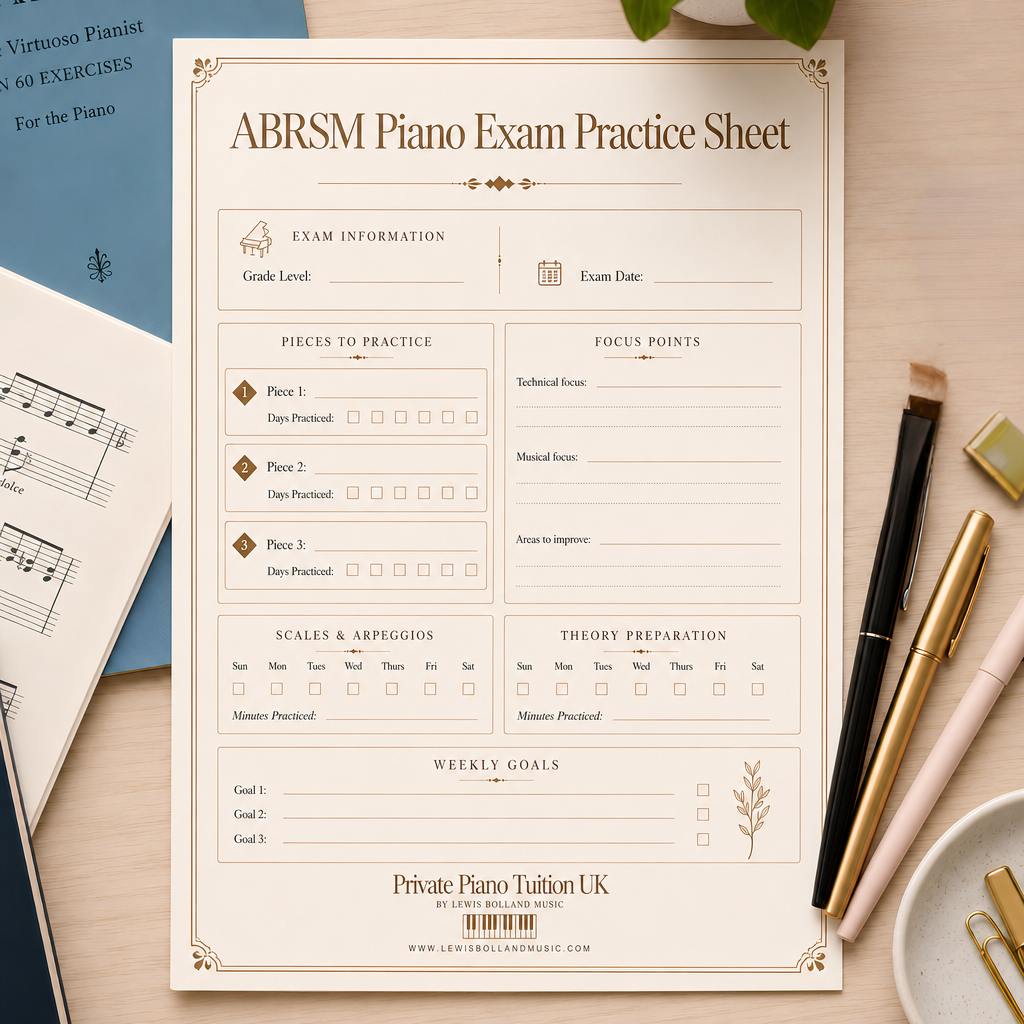
ABRSM Piano Exam Practice Sheet — A Printable Weekly Practice Planner is a clear, structured worksheet designed to help students prepare for graded piano exams with calm consistency and a simple plan.
This sheet brings everything into one place—so practice stays focused, measurable, and far less overwhelming. It’s ideal for students (and parents) who want to track progress week by week, without overcomplicating things.
It includes:
Exam information (grade level + exam date)
Pieces to practise (Piece 1–3 with day tick boxes)
Focus points (technical focus, musical focus, areas to improve)
Scales & arpeggios tracker (Sun–Sat + minutes practised)
Theory preparation tracker (Sun–Sat + minutes practised)
Weekly goals (Goal 1–3)
You’ll receive 2 pages (a clean colour version and a black & white version), so you can print whichever suits your setup.
Ideal for:
piano exam students
ABRSM learners (all levels)
parents supporting practice at home
teachers and studios
practice rooms and music classrooms
Designed to support structured, confident learning through Private Piano Tuition UK.
This is a digital download.
After purchase, you will receive a high-quality PDF file to download and print at home (or through a professional printing service).
🖨️ Printing
For best results, I recommend:
Printing on standard white paper or slightly thicker paper (120–160gsm)
Using the black & white version for everyday printing
Keeping completed sheets in a folder to track weekly progress over time
If you’d like this resized or adjusted (e.g., extra “Pieces” slots), feel free to get in touch — I’m always happy to help.
Small note (recommended for clarity)
This is an independent educational resource designed to support exam preparation and is not affiliated with or endorsed by ABRSM.
🔗 Need help getting started?
Honestly Just Play — A Blog by Private Piano Tuition UK
A growing resource designed to support students, parents, and adult learners with clear, honest advice.
🎹 Looking for piano lessons?
Private Piano Tuition UK — In-person piano lessons for all ages and abilities
Helping you build confidence, technique, and a genuine enjoyment of playing.
Progress towards Grade 1 is rarely about rushing; it is much more about building a steady routine and returning to the right things each week. If you would like a little extra support between lessons, I have created a collection of practice planners, music theory posters, and guidance resources in the Music Shop. They are designed to make home practice feel clearer, more organised, and hopefully a little more enjoyable too.
What I tend to recommend
For younger students, I generally find that working towards grades gives them something to aim for and a real sense of accomplishment when they get there. Children often respond well to the structure, and parents appreciate having a clear measure of progress. This is something I see regularly with families coming to me from across Basingstoke, Tadley, and the surrounding Hampshire villages.
For adults, I always have an honest conversation early on about what they actually want from lessons. If grades feel motivating, brilliant - let's work towards them. If they feel like pressure without purpose, we can absolutely build a rich, rewarding musical journey without them.
The most important thing, in my experience, is that the student is engaged, enjoying the process, and making progress that feels meaningful to them. That looks different for everyone - and that's exactly as it should be.
A note on practice
Whether you're working towards Grade 1 or simply learning for the love of it, practice is where the real progress happens. Lessons give you the direction; practice is where it becomes yours.
For complete beginners, ten to fifteen minutes a day is genuinely enough in the early stages. That's all. It doesn't need to be a long session — it just needs to happen regularly. As you progress and the music becomes more demanding, that time naturally increases - but there's no need to sit at the piano for hours from the very beginning. Consistency matters far more than duration, and that's something I remind every student at Private Piano Tuition UK, whether they're just starting out in Tadley or have been playing for years across Hampshire and Berkshire.
I hope this blog has been helpful - whether you're just starting out on your piano journey or somewhere in the middle of it. I hope it's inspired you to sit at the piano today.
If you'd like to find out more about who I am and how I teach, you're welcome to visit the Private Piano Tuition UK homepage here. I offer piano lessons in Tadley, Basingstoke, and across Hampshire, Berkshire, and the South of England—and this blog is here as a free resource for piano students and parents wherever you are.
I’ve also curated a collection of luxury music theory posters and learning resources in the Music Shop, designed to keep you inspired and progressing between lessons. You can explore the full range by clicking here.
If you're ready to take the next step, you can view lesson prices and information here.