

What Are the Benefits of Learning Piano? More Than You Might Think…
I get asked this question a lot - usually by parents wondering whether piano lessons are worth the investment, or by adults who are tempted to start but need a little convincing. So let me give you an honest answer, backed by both nineteen years of teaching experience and some genuinely fascinating research.
The short version: learning the piano is one of the best things you can do for your brain, your mental health, and your overall wellbeing - at any age.
It's good for your brain. Genuinely.
This isn't just something piano teachers say to make themselves feel better about their career choice. The science is real.
A study by the University of Bath found that beginners who took just one hour of piano lessons a week for eleven weeks showed significant improvements in how their brains processed sights and sounds - and reported measurable reductions in depression, stress and anxiety. Eleven weeks. That's not a long time at all.
Research published in Frontiers in Psychology found that children who received regular piano lessons showed significant improvements in verbal memory, spatial ability and literacy skills compared to those who didn't. And a long-term study found that adults who played music throughout their lives showed far less age-related decline in brain processing, memory and hearing.
Playing the piano engages more areas of the brain simultaneously than almost any other activity. You're reading, listening, coordinating both hands independently, processing rhythm, and expressing emotion - all at once. It's the closest thing to a full brain workout that I know of.
It's good for your mental health
This is the one I see most clearly in my own students at Private Piano Tuition UK - and it's the benefit I find most meaningful.
There's something that happens when a student sits down at the piano and loses themselves in a piece of music. The noise of the day quietens. The to-do list fades. For a few minutes, there is only the music - and that is genuinely restorative.
Studies show that people who play music regularly experience less anxiety, loneliness and depression. Playing piano has been shown to lower cortisol - the stress hormone - and trigger the release of dopamine, the brain's feel-good chemical. It's not just anecdotal. The research backs it up.
I've had adult students tell me that their weekly piano lesson is the one hour in the week that is entirely theirs. No emails, no responsibilities, no noise. Just them and the piano. That matters more than people realise.
It builds confidence - especially in children
There are very few feelings quite like mastering something difficult. Piano lessons give children - and adults - a steady, reliable source of that feeling.
Every new piece learned, every scale passed, every grade achieved is a moment of genuine accomplishment. And that sense of "I did that" carries over into other areas of life. Studies have shown that children who receive piano lessons score higher on self-esteem measures than those who don't - and I've seen this play out in my own teaching across Tadley, Basingstoke, and the wider Hampshire and Berkshire areas time and time again.
A child who arrives shy and uncertain at their first lesson at Private Piano Tuition UK, then performs a piece in front of their family six months later with a quiet confidence they didn't have before - that never gets old.
It improves focus, patience and discipline
Learning piano teaches you to sit with something difficult and work through it. You can't rush it. You can't skip the hard bits. You have to be patient, consistent, and willing to try again when it doesn't go right the first time.
Those are life skills - and they transfer. Children who learn an instrument tend to perform better academically, particularly in maths and reading. The discipline of regular practice builds habits of focus and perseverance that show up everywhere else.
For families considering children's piano lessons in Hampshire or Berkshire, this is often the benefit that surprises parents most - not just the music, but the mindset it builds.
It's good for you at every age
One of the things I love most about teaching piano is that it genuinely doesn't matter how old you are. The benefits are real whether you're five or seventy-five.
For children, piano lessons support cognitive development, language skills, coordination and confidence during some of the most formative years of their lives. For adults, adult piano lessons offer a creative outlet, a mental challenge, and a form of stress relief that is genuinely hard to find elsewhere. And for older adults, research has shown that learning piano can help delay cognitive decline, improve mood and quality of life, and even reduce symptoms of depression.
The piano doesn't care how old you are. It just asks that you show up.
And then there's the joy of it
I could cite studies all day - and the research really is compelling - but the truth is, the greatest benefit of learning piano is simply this: it brings joy.
The moment a student plays through a piece they've been working on and it finally comes together. The first time a child plays something their parents recognise. The adult who sits down after a long day and plays for twenty minutes and feels, genuinely, better for it.
That's what nineteen years of teaching has shown me more than anything else. The science is wonderful. But the joy is the thing.
One of the loveliest things about learning piano is making music part of everyday life. Sometimes, simply having a clear practice plan or a few beautiful musical references near the piano can make it easier to sit down and play. In the Music Shop, I have created a collection of elegant music theory posters, worksheets, and practice planners designed to support learners of all ages - whether you are just beginning or returning to the piano after some time away.
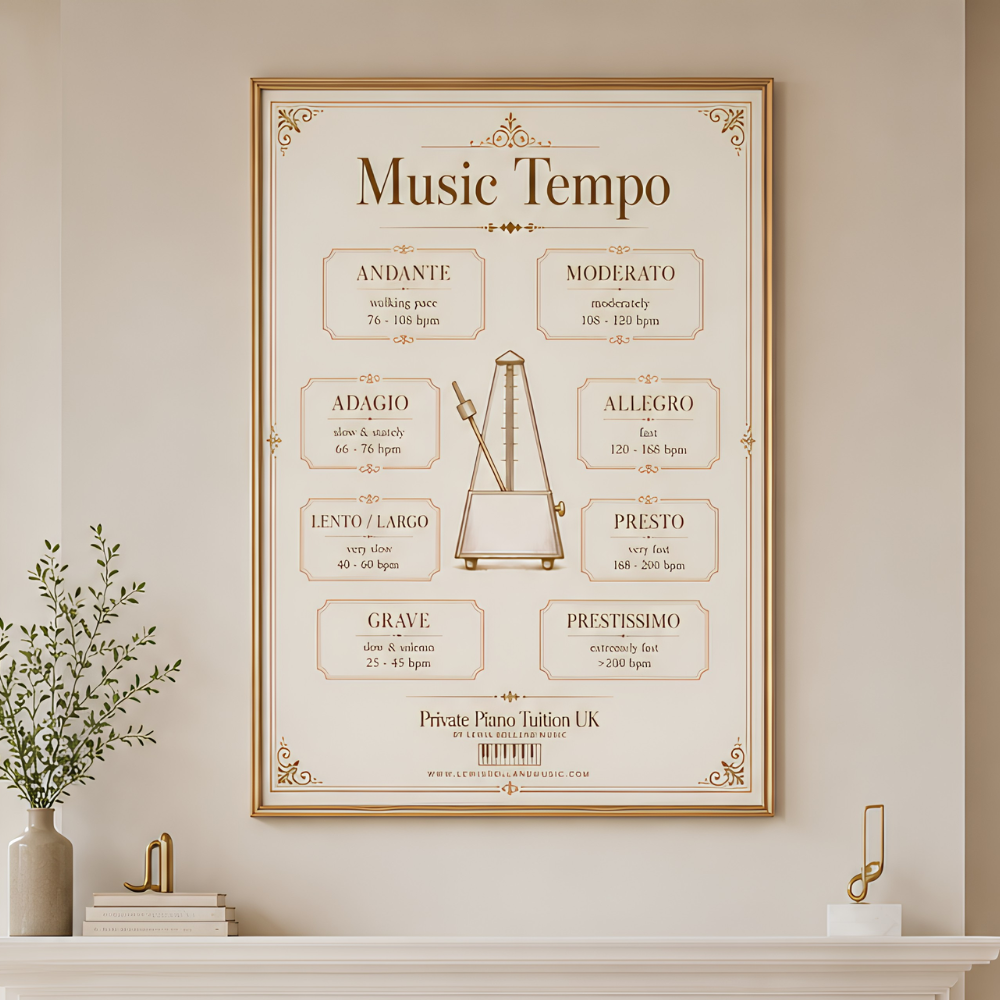
Music Tempo — A Metronome BPM Theory Chart is a clear and elegant visual guide designed to help students master the essential Italian terms and beats-per-minute (BPM) ranges that define the pace of music.
From the slow and solemn Grave to the extremely fast Prestissimo, this poster translates traditional tempo markings into easy-to-understand descriptions and precise metronome numbers. It serves as a beautiful side-by-side reference for practice rooms, helping students develop a better internal sense of timing and musical character.
It includes:
A complete range of Italian tempo markings from 25 BPM to over 200 BPM
Clear translations for each term (e.g., "walking pace" for Andante)
An elegant vintage-inspired metronome illustration
A refined, luxury layout designed for quick reference during practice
Whether you’re a beginner learning to use a metronome or an intermediate student preparing for ABRSM exams, this poster provides a practical and stylish reference to help you play with rhythmic precision and confidence.
Ideal for:
beginner piano students
music theory learners
practice rooms and home studios
music classrooms
parents supporting practice at home
Designed to support structured, confident learning through Private Piano Tuition UK.
This is a digital download.
After purchase, you will receive a high-quality A4 poster file to download and print at home or through a professional printing service.
🖨️ Printing
This poster has been designed in high resolution for professional printing.
For best results, I recommend:
Printing on premium matte or silk paper (200–300gsm)
Using a professional print service for the clearest detail and finish
It can be printed at home, but professional printing will give the most refined result.
If you would like this poster resized to a different size, please feel free to get in touch — I’m always happy to adjust it for you.
🔗 Need help getting started?
If you’re new to the piano or need guidance with anything from choosing the right instrument, preparing for exams, or learning at home, you can visit our blog:
Honestly Just Play — A Blog by Private Piano Tuition UK
A growing resource designed to support students, parents, and adult learners with clear, honest advice.
🎹 Looking for piano lessons?
If you’re searching for piano lessons in Tadley, Basingstoke, Hampshire or Berkshire, you can find out more and get in touch here:
Private Piano Tuition UK — In-person piano lessons for all ages and abilities
Helping you build confidence, technique, and a genuine enjoyment of playing.
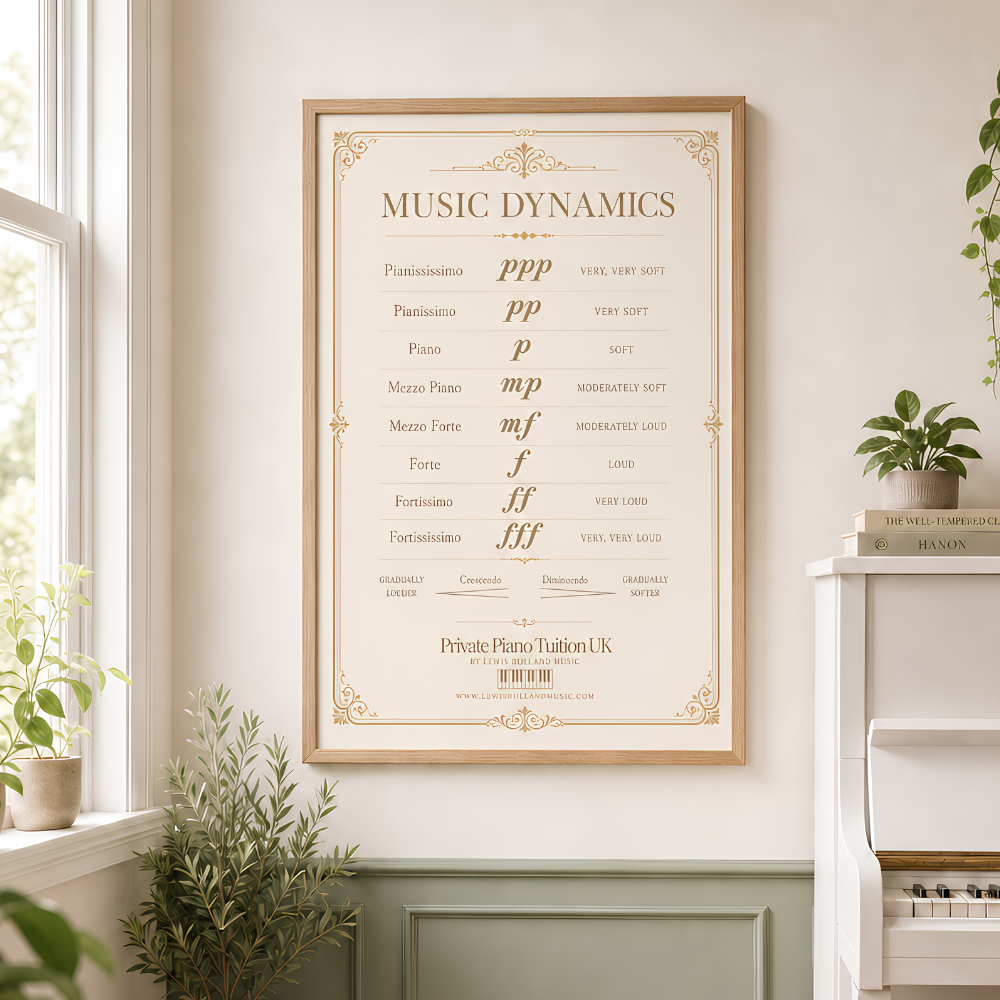
Music Dynamics — A Piano Theory Chart is a clear and elegant visual guide designed to help students understand dynamic markings and how volume and expression are communicated in music.
This poster supports expressive playing by clearly showing how dynamics shape musical performance, helping students move beyond simply playing the notes to truly bringing music to life.
It includes:
Common dynamic markings from ppp to fff
Italian terms including piano, forte, mezzo piano and more
Clear explanations to support expressive and confident playing
Whether you’re learning piano for the first time or progressing through ABRSM grades, this poster provides a practical reference to help you understand and apply dynamics with control and musicality.
Ideal for:
beginner piano students
music theory learners
practice rooms and studios
music classrooms
parents supporting learning at home
Designed to support structured, confident learning through Private Piano Tuition UK.
This is a digital download.
After purchase, you will receive a high-quality A4 poster file to download and print at home or through a professional printing service.
🖨️ Printing
This poster has been designed in high resolution for professional printing.
For best results, I recommend:
Printing on premium matte or silk paper (200–300gsm)
Using a professional print service for the clearest detail and finish
It can be printed at home, but professional printing will give the most refined result.
If you would like this poster resized to a different size, please feel free to get in touch — I’m always happy to adjust it for you.
🔗 Need help getting started?
If you’re new to the piano or need guidance with anything from choosing the right instrument, preparing for exams, or learning at home, you can visit our blog:
Honestly Just Play — A Blog by Private Piano Tuition UK
A growing resource designed to support students, parents, and adult learners with clear, honest advice.
🎹 Looking for piano lessons?
If you’re searching for piano lessons in Tadley, Basingstoke, Hampshire or Berkshire, you can find out more and get in touch here:
Private Piano Tuition UK — In-person piano lessons for all ages and abilities
Helping you build confidence, technique, and a genuine enjoyment of playing.
I hope this blog has been helpful - whether you're just starting out on your piano journey or somewhere in the middle of it. I hope it's inspired you to sit at the piano today.
If you'd like to find out more about who I am and how I teach, you're welcome to visit the Private Piano Tuition UK homepage here. I offer piano lessons in Tadley, Basingstoke, and across Hampshire, Berkshire, and the South of England—and this blog is here as a free resource for piano students and parents wherever you are.
I’ve also curated a collection of luxury music theory posters and learning resources in the Music Shop, designed to keep you inspired and progressing between lessons. You can explore the full range by clicking here.
If you're ready to take the next step, you can view lesson prices and information here.