

It's one of the questions I get asked most often by parents, and honestly, it's never a straightforward answer - because the truth is, it can be completely different for every child.
What matters far more than a number is whether a child is ready - physically, emotionally, and in terms of their curiosity about music. That said, I do have a view on this, and I think it's worth sharing.
It's all about finger strength.
When I meet a young student for the first time - usually somewhere between the ages of four and six - the very first thing I look at is finger strength. It sounds quite specific, but it genuinely shapes how early lessons go.
Most of us - children and adults alike - have reasonably strong thumbs, index fingers, and middle fingers. But the ring finger and little finger are naturally weak in everyone. That's just how we're built. And for piano, those fingers matter.
When a child starts piano lessons without that strength yet developed, the early weeks can become more about building physical capability than actually learning music. That's not the end of the world - it's something I'm very happy to work through - but it does mean progress can feel slower than it needs to be, which isn't always the most encouraging start.
What you can do at home before lessons begin?
Here's something I always say to parents of younger children: if you have a piano or keyboard at home, let your little ones explore it. Even at two or three years old, just having them sit at it, press the keys, and get comfortable with the instrument is genuinely valuable.
It doesn't need to be structured. It doesn't need to be musical. It just needs to be fun and familiar.
That early exposure does two things. It builds a natural enthusiasm for the piano - it becomes an exciting place rather than a formal one - and it quietly begins to develop finger strength in a completely natural way. By the time piano lessons start, some of that groundwork is already done.
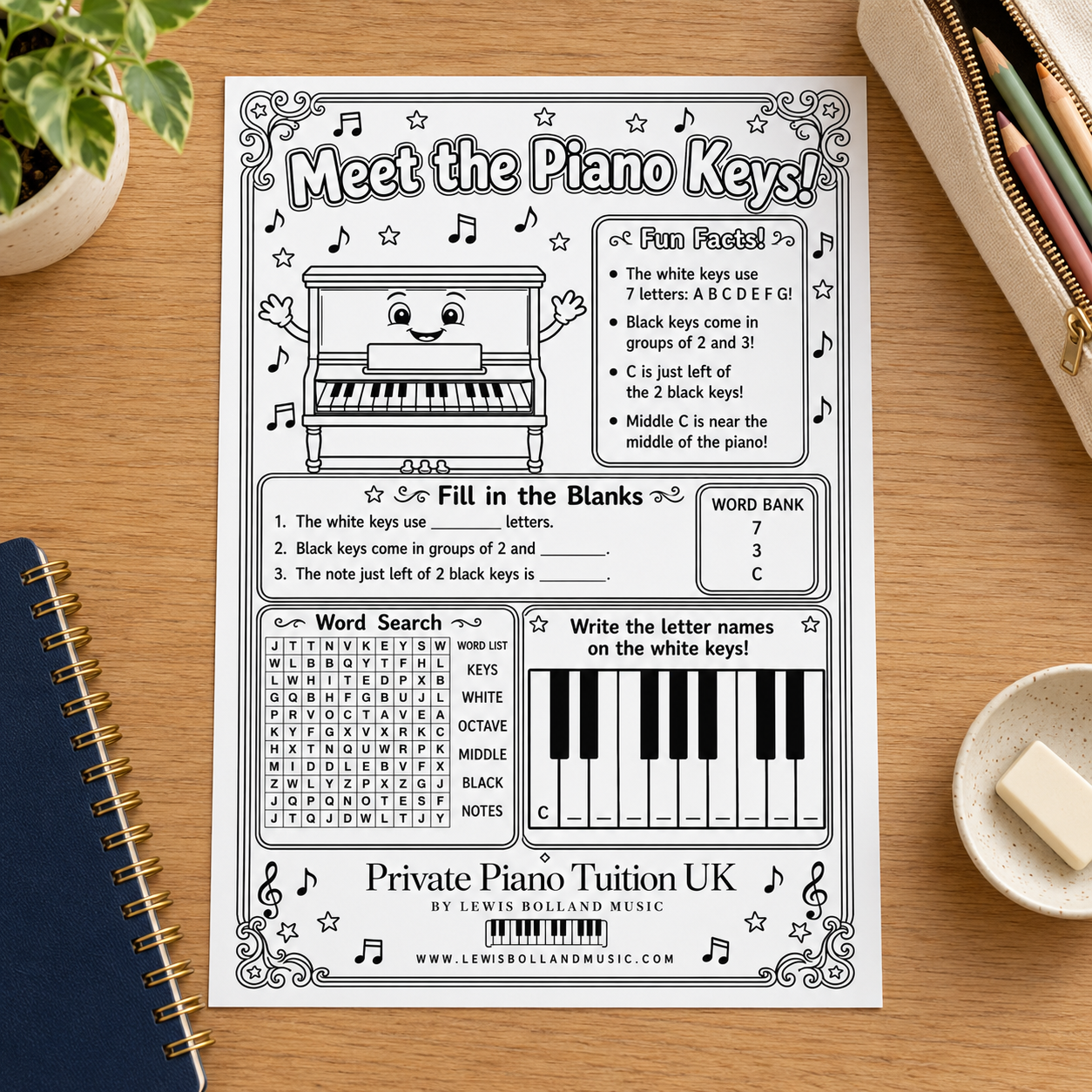
Meet the Piano Keys - A Printable Music Activity Worksheet is a fun, creative introduction to the piano keyboard, designed to help young beginners discover key patterns and musical letter names.
Through simple facts and practical activities, children explore the seven letters used for the white keys, the groups of two and three black keys, and how to find C on the keyboard.
It includes:
A Fun Facts section introducing white keys, black-key patterns and Middle C
Three fill-in-the-blank questions with a helpful word bank
A six-word music-themed word search
A keyboard activity to practise writing the letter names on the white keys
A clear black-and-white layout for easy printing
Whether you’re introducing the keyboard in a first piano lesson or exploring music together at home, this worksheet offers a simple, playful way to build familiarity and confidence.
Ideal for:
Young beginner piano students
Parents supporting learning at home
Piano teachers and music studios
Primary music classrooms
Home educators
Designed to support structured, confident learning through Private Piano Tuition UK.
This is a digital download.
After purchase, you will receive one A4 PDF worksheet to download and print at home or through a professional printing service. No physical item will be sent.
The PDF supplied is without the copyright wrap shown in the preview image.
🖨️ Printing
For best results, I recommend:
Printing on standard white A4 paper or slightly thicker stock (120-160gsm)
Selecting “Fit to page” to keep the decorative border visible
Using a pencil for the written activities
Keeping completed worksheets in a folder to revisit as learning progresses
If you’d like this resized or formatted differently, feel free to get in touch - I’m always happy to help.
🔗 Need help getting started?
Honestly Just Play - A Blog by Private Piano Tuition UK
A growing resource designed to support students, parents, and adult learners with clear, honest advice.
🎹 Looking for piano lessons?
Private Piano Tuition UK - In-person piano lessons for all ages and abilities
Helping you build confidence, technique, and a genuine enjoyment of playing.
So what age do I typically start students?
I generally don't take students younger than five, and even at five I always offer a taster lesson first. That session gives me a chance to meet the child, see how they respond, check their finger strength, and have an honest conversation with parents about whether now is the right time or whether a few more months might serve them better.
I've had students start just before their fifth birthday with wonderful finger strength and a real readiness for it. I've also had students closer to seven where the strength simply wasn't there yet. Age alone doesn't tell the whole story.
Children's piano lessons - what parents ask most
Across the UK, one of the most common questions parents ask is "when should my child start piano lessons?" And the honest answer, from someone who has taught children of all ages and abilities, is this: the right age is the age at which your child is curious, physically ready, and able to focus for short periods.
For most children, that tends to fall somewhere between five and seven. But every child is different, and a private piano teacher who takes the time to assess that individually - rather than simply accepting any student at any age - will always give your child a better start.
Whether you're based locally in Tadley, Basingstoke, Hampshire, or Berkshire, or you've simply found this blog while researching piano lessons for your child - I hope this gives you something genuinely useful to take away.
This blog exists because I believe every parent deserves honest, experience-based advice about learning piano - not just a sales pitch. If you're local and would like to explore lessons, I'd love to hear from you. And if you're further afield, I hope this helps you find the right path for your child wherever you are.
The most important thing
If your child is showing an interest in the piano, that's a really lovely sign. Nurture it. Make the instrument feel exciting and accessible at home. And when the time feels right, get in touch and we'll take it from there together.
There's no rush, and there's no single right answer. Every child is different, and the best start is always the one that's right for them.
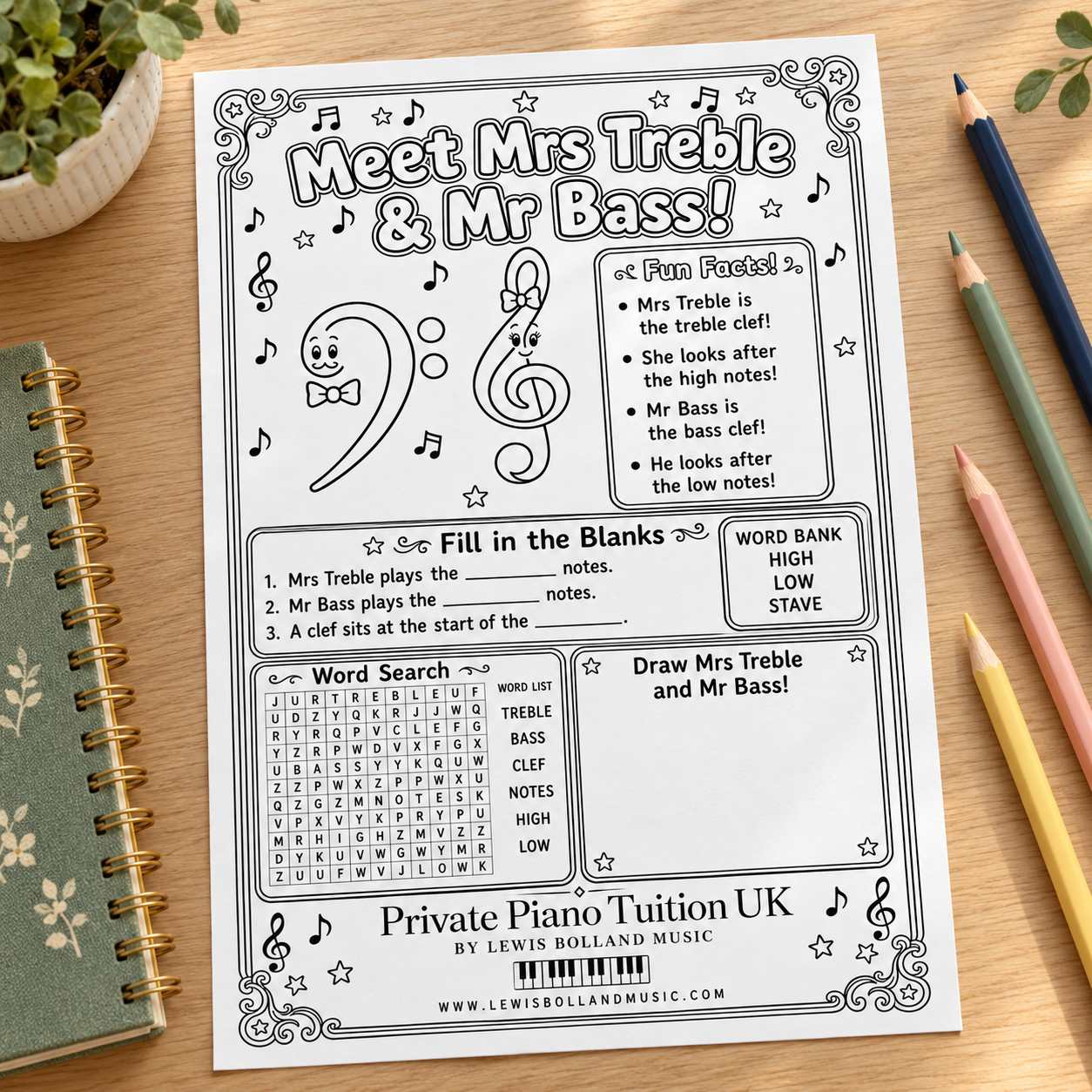
Meet Mrs Treble and Mr Bass - A Printable Music Activity Worksheet is a fun, creative introduction to the treble and bass clefs, designed to make learning about music enjoyable for young beginners.
Through two playful characters, children discover how the treble clef is associated with higher notes and the bass clef with lower notes. Simple facts, word-finding and drawing activities help bring these musical symbols to life.
It includes:
Mrs Treble and Mr Bass character illustrations to colour in
A Fun Facts section introducing the treble and bass clefs
Three fill-in-the-blank questions with a helpful word bank
A six-word music-themed word search
A space to draw Mrs Treble and Mr Bass
A clear black-and-white layout for easy printing
Whether you’re introducing clefs in a first piano lesson or exploring music together at home, this worksheet offers a simple, playful way to encourage curiosity and build familiarity with musical notation.
Ideal for:
Young beginner music students
Parents supporting learning at home
Piano teachers and music studios
Primary music classrooms
Home educators
Designed to support structured, confident learning through Private Piano Tuition UK.
This is a digital download.
After purchase, you will receive one A4 PDF worksheet to download and print at home or through a professional printing service. No physical item will be sent.
The PDF supplied is without the copyright wrap shown in the preview image.
🖨️ Printing
For best results, I recommend:
Printing on standard white A4 paper or slightly thicker stock (120-160gsm)
Selecting “Fit to page” to keep the decorative border visible
Using pencils or colouring pencils for the activities
Keeping completed worksheets in a folder to revisit as learning progresses
If you’d like this resized or formatted differently, feel free to get in touch - I’m always happy to help.
🔗 Need help getting started?
Honestly Just Play - A Blog by Private Piano Tuition UK
A growing resource designed to support students, parents, and adult learners with clear, honest advice.
🎹 Looking for piano lessons?
Private Piano Tuition UK - In-person piano lessons for all ages and abilities
Helping you build confidence, technique, and a genuine enjoyment of playing.
I hope this blog has been helpful - whether you're just starting out on your piano journey or somewhere in the middle of it. I hope it's inspired you to sit at the piano today.
If you'd like to find out more about who I am and how I teach, you're welcome to visit the Private Piano Tuition UK homepage here. I offer piano lessons in Tadley, Basingstoke, and across Hampshire, Berkshire, and the South of England—and this blog is here as a free resource for piano students and parents wherever you are.
I’ve also curated a collection of luxury music theory posters and learning resources in the Music Shop, designed to keep you inspired and progressing between lessons. You can explore the full range by clicking here.
If you're ready to take the next step, you can view lesson prices and information here.